
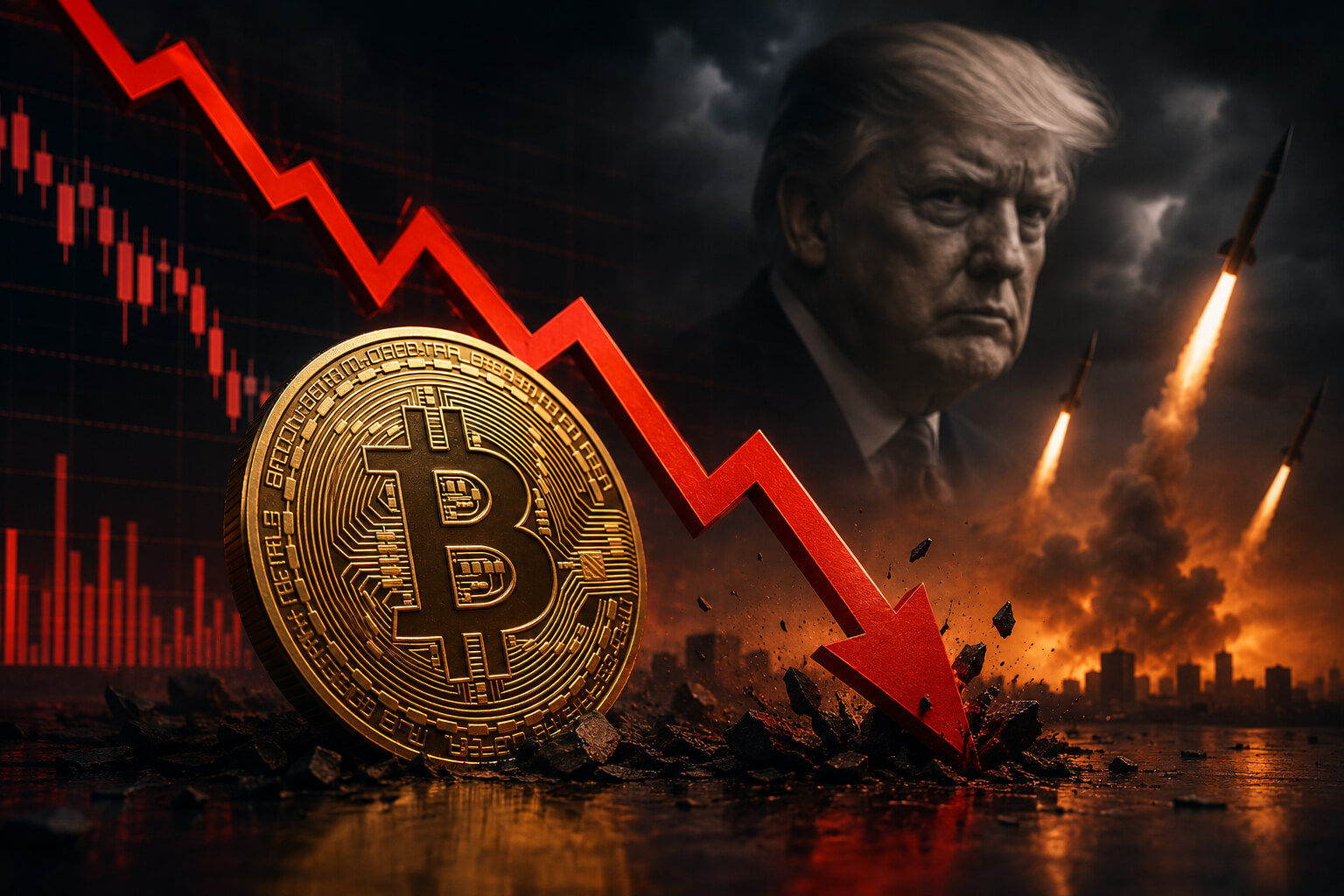
Bitcoin slipped below $65,000 on July 23 as another sharp escalation between the United States and Iran pushed investors away from riskier assets.
The world’s largest cryptocurrency fell to around $64,800, losing roughly 1.5% during Thursday trading. Bitcoin had tried to regain momentum earlier in the week, but the recovery did not last long.
Then the political headlines landed.
US President Donald Trump said he was close to deciding whether to restart large-scale military operations against Iran. He described the possible action as a “massive attack” that could be bigger than previous US strikes. No final order had been issued at the time of his comments.
Trump’s Iran Warning Quickly Hit Bitcoin
Trump told Axios that the United States was prepared for a much larger military operation against Iran, although he did not provide a timetable for making the decision.
Two US officials reportedly said the White House had not approved a new attack or issued fresh military orders. That distinction did little to calm markets.
Bitcoin traders tend to react first and ask questions later when war risks suddenly increase. BTC moved below the closely watched $65,000 level as investors reconsidered their exposure to volatile assets.
The decline was not a dramatic crypto crash. Still, it showed how fragile Bitcoin’s latest recovery had become.
Bitcoin was already struggling to hold its ground above $66,000. The Iran warning gave sellers another reason to take control.
Bitcoin Is Still Trading Like a Risk Asset
Bitcoin supporters often describe the cryptocurrency as digital gold. During sudden geopolitical shocks, though, it does not always behave like a traditional safe-haven asset.
Traders frequently sell Bitcoin alongside technology stocks and other speculative investments when uncertainty rises. Cash, the US dollar and short-term government debt often attract more immediate demand.
That pattern appeared again following Trump’s comments.
The market did not treat Bitcoin as protection from military conflict. It treated BTC as an asset that could suffer if the war pushed energy prices higher, lifted inflation and forced central banks to keep monetary policy tight.
Not quite the digital-gold reaction bulls would hope to see.
Oil Above $100 Added More Pressure
The military threat was only part of the problem.
Brent crude climbed above $100 per barrel after Iran-backed Houthi forces claimed attacks on Saudi oil tankers in the Red Sea. West Texas Intermediate also moved sharply higher.
One Saudi tanker reportedly caught fire near its bow, although officials said the crew remained safe. Other vessels changed course after warnings about further attacks.
Those disruptions matter because the Red Sea, the Strait of Hormuz and the Bab el-Mandeb Strait sit along some of the world’s most important energy shipping routes. A prolonged conflict could restrict oil exports and drive fuel prices much higher.
Brent crude futures rose about 7% to $100.66 per barrel, while WTI gained roughly 6.3% to $92.28. The move placed oil back above $100 for the first time since late May.
Higher Oil Prices Could Keep Interest Rates Elevated
Oil at $100 does not stay inside the energy market.
Higher transport and fuel costs can spread through supply chains, raise consumer prices and complicate the inflation outlook. That is where the situation becomes uncomfortable for Bitcoin.
Crypto markets generally benefit from falling interest rates and easier financial conditions. Expensive borrowing and persistent inflation usually work in the opposite direction.
If the Iran conflict keeps oil prices elevated, the US Federal Reserve may have less room to reduce rates. Markets could even begin pricing in further tightening if inflation accelerates again.
That would leave Bitcoin fighting both geopolitical uncertainty and restrictive monetary policy. Neither is particularly helpful when buyers are already hesitant.
Binance Research Sees Pressure Continuing Through the Third Quarter
Bitcoin’s weakness may not disappear once the latest headlines fade.
Binance Research analysts said macroeconomic pressure could continue limiting BTC’s performance through the third quarter. Bitcoin ended the first half of 2026 near $59,500, roughly 53% below the record high of more than $120,000 reached in October 2025.
The analysts suggested Bitcoin may be approaching a historical bottoming period ahead of the fourth quarter. That is not a confirmed bottom, though. It is a possibility based on previous market cycles.
Crypto markets have a habit of making those historical comparisons look convincing—right until they stop working.
For now, Bitcoin’s failure to hold $65,000 keeps the market vulnerable to another test of its July lows.
The $65,000 Level Has Become a Key Battleground
Bitcoin’s short-term direction may depend on whether buyers can reclaim the area between $65,000 and $67,000.
Recent market data showed buying interest concentrated between roughly $64,500 and $65,500. Sellers, meanwhile, had built larger positions around $67,000 and $68,000.
That creates a narrow and uncomfortable trading range.
A strong recovery above $67,000 could improve momentum and reopen the path toward $70,000. A sustained break below the current support zone may expose Bitcoin to a deeper decline toward $63,500 or the previous July lows.
The chart matters, but headlines may matter more for the next few sessions.
One statement from Washington, Tehran or another regional government could quickly move oil, the dollar and Bitcoin at the same time.
Bitcoin Traders Are Watching War, Oil and the Fed
Bitcoin is no longer reacting to a single market story.
Traders now have to track military developments in the Middle East, attacks on shipping routes, crude oil prices, inflation expectations and the Federal Reserve’s next policy decision.
That is a messy combination.
A diplomatic breakthrough could ease oil prices and give Bitcoin space to recover. A new US attack on Iran would probably create another wave of volatility across crypto and traditional markets.
Bitcoin remains above its late-June low, so the broader recovery has not completely collapsed. Still, the move below $65,000 makes one thing clear: confidence remains thin.
Right now, Bitcoin is trading less like an escape from global uncertainty and more like a live scoreboard for it.
This article is for informational purposes only and does not constitute financial or investment advice.