
The European Union is tightening its financial restrictions on Russia again. This time, crypto platforms operating beyond the bloc’s borders are sitting much closer to the center of the crackdown.
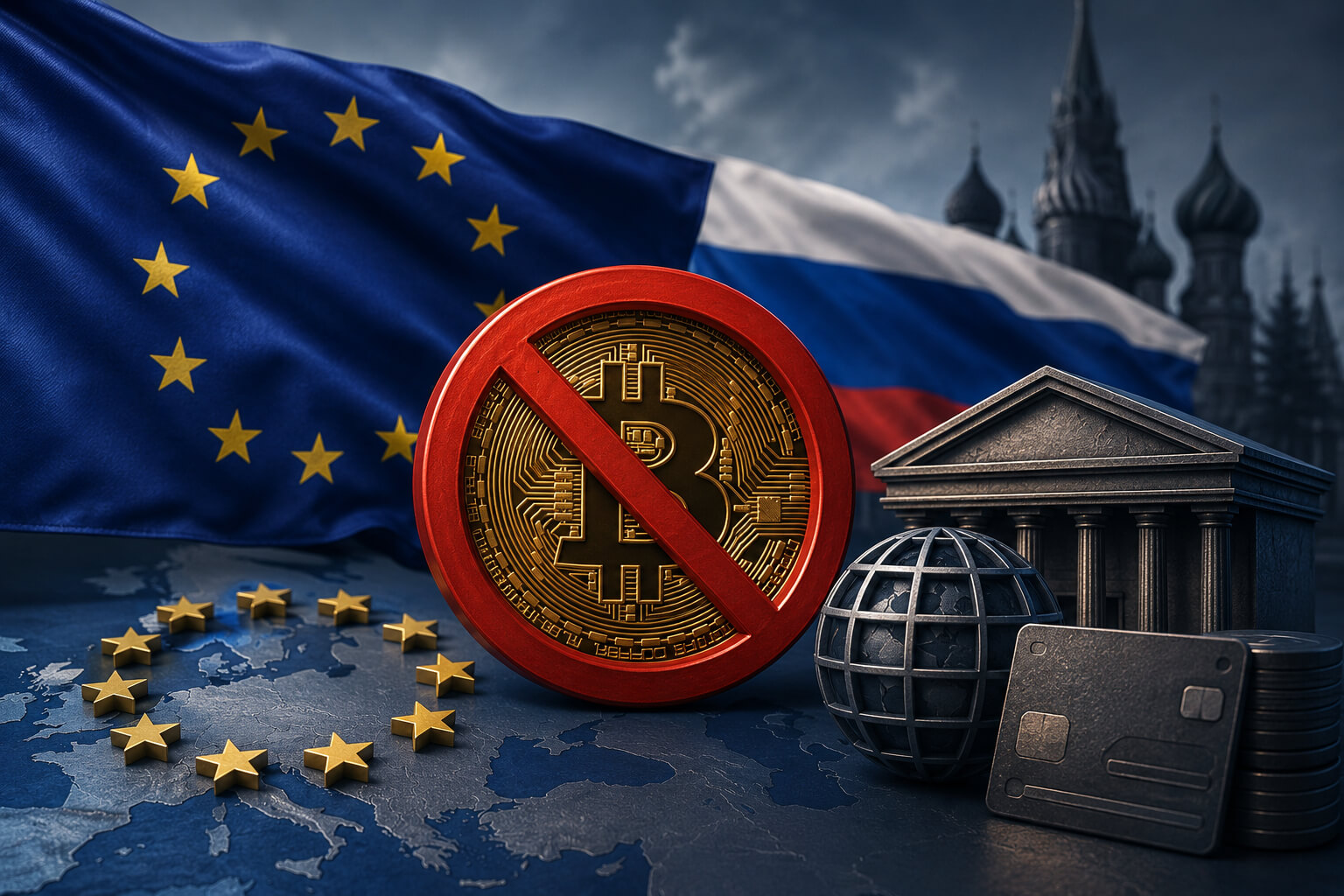
Under its 21st sanctions package, adopted on July 23, the EU imposed transaction bans on foreign cryptocurrency services and banks accused of helping Russia move money, maintain trade connections or work around existing restrictions.
The package targets 14 crypto-related service platforms based across Georgia, Panama, the United Arab Emirates, the Marshall Islands, Kyrgyzstan and Belarus. It also covers additional Russian financial institutions and four banks located outside Russia.
This is no longer just about stopping European exchanges from serving sanctioned Russian customers. Brussels is reaching further into the overseas infrastructure that may be keeping those financial routes open.
EU Expands Its Crypto Sanctions Beyond Russia
The most striking part of the package is a new mechanism that could allow the EU to impose a complete transaction ban on crypto-asset services in an entire third country.
That is a significant shift.
Rather than blacklisting one exchange at a time, the EU could potentially block transactions between European operators and crypto providers across a jurisdiction that repeatedly allows platforms to support Russian sanctions evasion.
The Council of the European Union described the measure as a deterrent for countries hosting services that help Russia bypass EU restrictions. Once applied, European businesses would be unable to transact with crypto providers covered by the prohibition.
The instrument gives Brussels a much wider reach. It also puts pressure on regulators outside Europe to take action against exchanges and payment services operating within their borders.
Fourteen Foreign Crypto Platforms Face Transaction Bans
The sanctions package extends transaction bans to 14 crypto-related platforms in six jurisdictions.
The Council’s announcement did not frame these platforms as ordinary offshore exchanges that happened to serve Russian customers. EU officials tied the restrictions to services allegedly used by Russia to avoid financial sanctions and preserve access to international payment channels.
European operators will now face restrictions on conducting direct or indirect transactions with the listed services.
That could affect more than customer deposits and withdrawals. Depending on how authorities enforce the rules, the restrictions may also influence liquidity relationships, payment processing, custody arrangements, institutional counterparties and other business links involving companies inside the EU.
For crypto businesses, the message is getting harder to ignore: geographic distance from Europe does not automatically place a platform beyond the reach of European sanctions.
The A7 Network Remains a Major EU Concern
The EU also added four designations connected to the cross-border A7 financial network, including newer links between the network and Africa.
A7 has repeatedly appeared in Western efforts to track Russia-linked payment infrastructure. The network has been associated with alternative settlement channels designed to reduce reliance on conventional banking systems.
Earlier European sanctions targeted A7A5, a ruble-backed stablecoin linked to the network. The EU prohibited transactions involving the asset and sanctioned companies connected to its development and issuance.
The latest designations suggest that European officials believe the network is still expanding rather than fading away.
Crypto makes that expansion more difficult to contain. A token can move between wallets, exchanges, brokers and jurisdictions without following the same path as a traditional international bank transfer. That does not make the funds invisible, but it can make enforcement slower and considerably messier.
Banks Are Caught in the Same Financial Net
Crypto platforms are only one part of the EU’s latest financial measures.
The package introduces transaction bans involving 33 additional Russian credit and financial institutions. Four banks based in non-EU countries are also covered because of their alleged role in supporting Russian financial activity or frustrating earlier sanctions.
This combination matters.
Russia’s alternative payment routes do not operate through crypto alone. Banks, informal brokers, stablecoins, payment agents and offshore trading companies can all form pieces of the same settlement chain.
A company might receive cryptocurrency through one platform, convert it through another service and eventually settle the payment through a bank in a separate country. Targeting only the exchange would leave much of that route untouched.
The EU is now trying to restrict the full chain.
Brussels Has Been Building Toward a Broader Crypto Crackdown
The 21st package did not appear out of nowhere.
In its 19th sanctions package, the EU targeted the A7A5 stablecoin, its developer, its Kyrgyz issuer and an associated trading platform. It also prohibited the use of the cryptocurrency within the bloc.
The 20th package went further by introducing a sector-wide ban on transactions with Russian crypto-asset service providers and decentralized platforms enabling crypto trading. It also targeted another ruble-linked cryptocurrency, RUBx, and restricted payment agents allegedly helping Russian entities complete international transactions.
Now the focus has widened to foreign platforms and the countries hosting them.
The direction is fairly clear. EU authorities increasingly view cryptocurrency not as a separate sanctions issue, but as part of the broader financial infrastructure surrounding Russian trade and capital flows.
Foreign Exchanges May Face More Compliance Pressure
Crypto platforms outside the EU may need to examine their exposure to Russian customers, sanctioned entities and counterparties more carefully.
Simply operating from an offshore jurisdiction will not remove the risk.
An exchange could lose access to European partners if regulators determine that it facilitates prohibited Russian transactions. Banks and payment processors may also cut ties before authorities formally require them to do so. Few financial companies want to discover that one of their counterparties has become the next name on an EU sanctions list.
That pressure will likely produce more aggressive customer screening, wallet monitoring and source-of-funds checks.
It may also create problems for legitimate users. Compliance systems can flag transactions because of indirect wallet connections, shared infrastructure or exposure to a service that handled sanctioned funds somewhere earlier in the chain.
Sanctions enforcement rarely stays neatly contained.
Crypto Has Not Replaced Banks, but It Complicates Enforcement
The latest EU action does not prove that Russia has replaced conventional finance with cryptocurrency. Banks and commodity revenue still carry far more weight in the Russian economy.
Crypto does, however, provide another route when traditional channels close.
Stablecoins can help settle cross-border transactions without waiting for correspondent banks. Offshore exchanges can convert assets between currencies. Decentralized platforms may provide liquidity without operating through a conventional financial institution.
None of those systems is automatically illegal. Their role changes when sanctioned individuals, companies or state-linked networks use them to move funds that regulated banks would reject.
That is the gap Brussels is trying to close.
EU Russia Crypto Sanctions Could Reach Further
The 21st package marks one of the EU’s strongest attempts yet to extend crypto-related restrictions beyond Russia itself.
Fourteen overseas platforms now face transaction bans. More banks have been cut off. A new country-level mechanism gives the bloc the option to target jurisdictions that continue hosting services used for sanctions evasion.
The real test will come through enforcement.
Crypto platforms can rename themselves, shift infrastructure and move legal entities across borders. Payment networks can also replace one intermediary with another. Sanctions may disrupt those systems, but they do not always eliminate them.
Still, the EU has made its position unusually direct: foreign crypto companies that maintain financial routes for Russia may eventually lose access to Europe altogether.
Sources
- Crypto.news – EU eyes ban on foreign crypto services linked to Russia sanctions evasion
- Council of the European Union – 21st package of sanctions targets financial services and crypto
- Council of the European Union – Timeline of sanctions packages against Russia
- European Commission – EU adopts 20th package of sanctions against Russia