
Crypto hardware wallets used to feel like small USB devices built for people who already knew what they were doing.
Now the market is changing. A newer group of cold wallets looks more like a bank card than a tech gadget. You tap it with your phone. It signs the transaction through NFC. No charging. No cable. No Bluetooth pairing. Just a card, an app, and your crypto keys sitting offline.
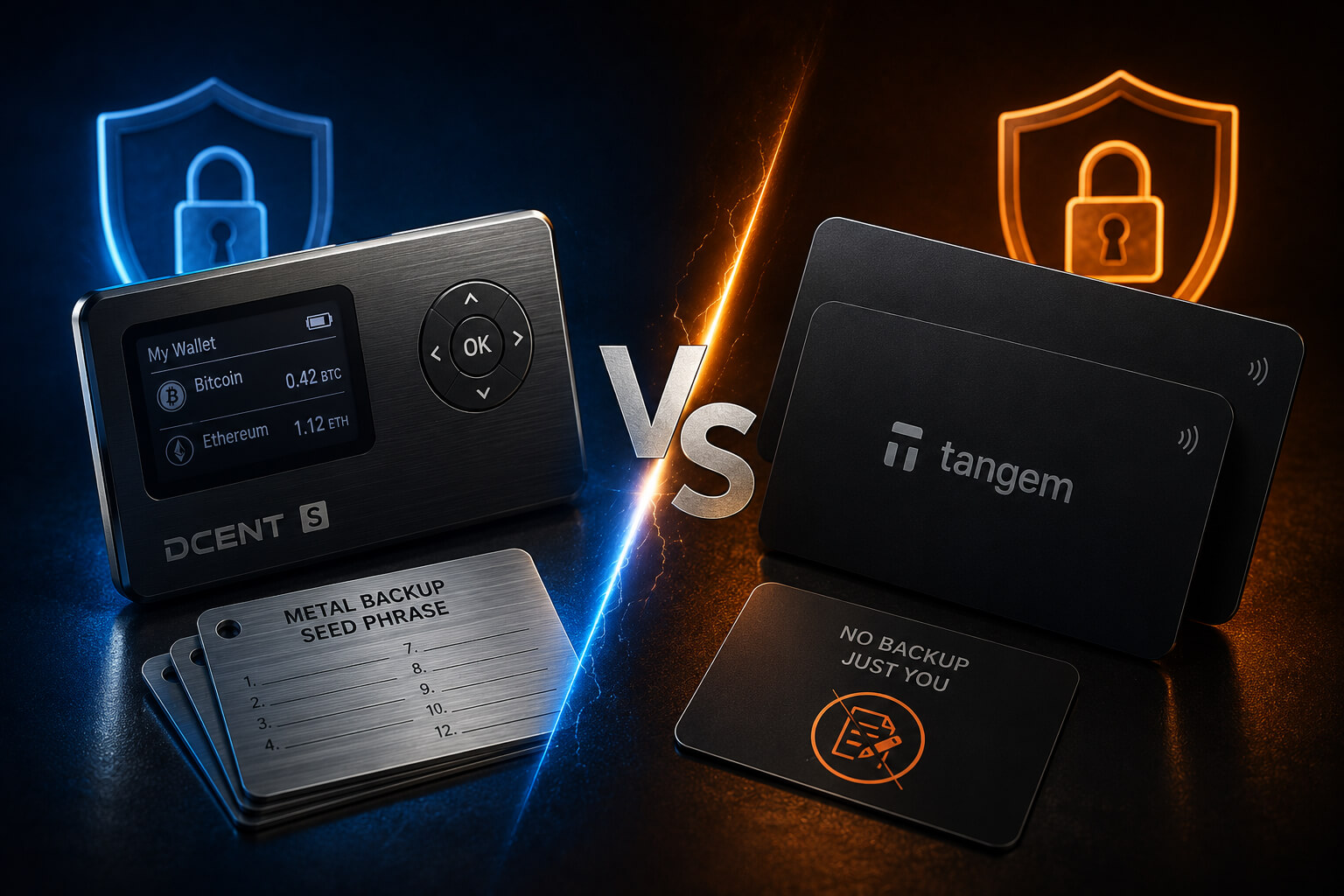
That is where DCENT S vs Tangem gets interesting.
Both wallets are trying to make self-custody less intimidating. Both use card-style hardware. Both lean on secure chips. Both are designed for mobile users who do not want to carry around a traditional hardware wallet.
But they disagree on one very important thing: what should happen if you lose your wallet.
DCENT S and Tangem Are Built for Simpler Self-Custody
DCENT S is the newer product in this matchup. It launched in July 2026 as a card-format wallet from IOTRUST, the South Korean company behind the D’CENT hardware wallet ecosystem. The idea is simple enough: a slim NFC cold wallet that comes with a separate recovery card.
Tangem has been around longer and has already built a name around seedless card wallets. Instead of giving users one main wallet and one recovery-only card, Tangem usually ships wallet sets with two or three identical cards. It also offers a ring version for users who want a wearable crypto wallet.
At a glance, they look like close rivals. In actual use, the difference is not cosmetic. It is structural.
The Backup System Is the Real Difference
DCENT S uses what it calls the R3covery Card. Every kit includes a main DCENT S card for transactions and a separate recovery card for restoring access if the main card is lost.
That recovery card does not sign transactions. It is not meant for daily spending, swapping, or moving coins. Its job is recovery only.
That creates a cleaner split between daily use and emergency access. Store the DCENT S card in your wallet. Keep the R3covery Card somewhere else. The whole point is to avoid putting everything in one place.
Tangem takes a more convenient route. Its backup cards are identical working cards. Each card in the set can access the same wallet after setup. Lose one, and you can keep using another.
Very easy. Maybe too easy, depending on how you think about risk.
If someone steals a Tangem backup card and also gets the access code, that card can sign transactions. With DCENT S, the recovery card cannot move funds on its own. That does not make DCENT S magically risk-free, but it does make the backup model feel more separated.
Security Looks Similar on Paper, but Trust Still Matters
Both DCENT S and Tangem use EAL6+ secure elements, which is the kind of security language crypto wallet companies love to repeat. In plain English, the private key is generated and stored inside a secure chip, not inside your phone, not in the cloud, and not on a company server.
That part matters.
A card wallet depends heavily on its chip and mobile app. There is no screen on the card itself, so you cannot verify transaction details directly on the hardware device the way you can with some traditional wallets. You review the transaction in the app, then tap the card to sign.
For casual users, that feels smooth. For security-heavy users, it is a compromise.
Tangem has a transparency edge because its firmware has gone through outside audits, including audits by Kudelski Security and Riscure, according to the Cryptonews comparison. DCENT S is newer, and the same report notes that equivalent published third-party audit results were not yet available at the time of writing.
So the security comparison is not only about chip certification. It is also about what has been independently reviewed, what has been published, and how much trust users are willing to place in each wallet maker.
Supported Coins: Tangem Has the Bigger Number
Tangem supports more than 14,000 tokens across more than 90 blockchain networks, according to the Cryptonews comparison.
DCENT S supports more than 4,900 assets across more than 100 networks, based on D’CENT’s own product page.
That sounds like Tangem wins easily. Maybe. But token counts can be a little misleading. A wallet can list thousands of tokens because many assets live on the same supported networks.
For most people, the real question is simpler: does the wallet support Bitcoin, Ethereum, Solana, XRP, BNB Chain, Polygon, stablecoins, and whatever else they actually hold?
For many users, both wallets will cover the basics.
XRP Users May Look Harder at DCENT S
DCENT S makes a stronger case for XRP users.
The Cryptonews comparison points out that DCENT S emphasizes fuller XRP Ledger support, including Trust Lines, decentralized apps, swaps, sending, receiving, and holding XRP. Tangem also supports XRP, but it does not appear to position XRP as heavily in its main pitch.
That difference matters for people who use XRP beyond simply holding it.
Someone who only holds a small XRP balance may not care. Someone active on XRPL might care a lot.
Daily Use Feels Almost Too Easy
Both wallets are designed around NFC signing.
Open the app. Choose the transaction. Tap the card against your phone. Sign. Done.
There is no charging because the card gets power from the phone’s NFC field. No cable. No Bluetooth. No pairing process that randomly fails at the worst possible moment.
That is the appeal of this whole category. It makes cold storage feel less like cold storage.
The trade-off is that these wallets depend heavily on the phone app experience. The app becomes the place where you view balances, approve transaction details, manage assets, and connect with other crypto tools.
Tangem’s app has been around longer and includes features such as swaps, staking for supported assets, dApp connectivity, and portfolio tracking. DCENT’s app is also functional and supports the broader D’CENT wallet ecosystem, but Tangem appears more mature on the app side.
Design: Card vs Card, Plus a Ring
DCENT S and Tangem both use the card format because it works. People already know how to carry cards. A crypto wallet that fits into the same slot as a bank card instantly feels less intimidating.
DCENT S is very thin and built around the main-card-plus-recovery-card setup. Tangem also offers the familiar card design, but it has one extra trick: the Tangem Ring.
The ring will not be for everyone. Some people will find it clever. Others will think it is too flashy for a crypto wallet. Still, it gives Tangem a design advantage for users who want wearable access instead of another card in their wallet.
Both products are built for rough daily life. The Cryptonews comparison lists DCENT S with an IP69 rating and Tangem with IP69K, meaning both are designed to survive dust, water, and normal physical abuse.
Which One Is Better?
There is no perfectly neutral answer here.
Tangem feels stronger for users who want convenience, more token support, a polished app, and backup cards that work immediately. If one card disappears, another card can keep you moving. That is simple, and simple wins often in crypto.
DCENT S feels stronger for users who care more about separating recovery from spending. The R3covery Card not being able to sign transactions is the headline feature. It makes the wallet feel a bit more deliberate, especially for users who worry about backup cards becoming another attack surface.
For XRP-heavy users, DCENT S also has a clearer pitch.
So the choice is not really “which card wallet is best?” It is more like this:
Tangem is the easier everyday setup.
DCENT S is the more recovery-focused design.
Different users will hear those sentences differently.
Card Wallets Are Making Crypto Custody Less Weird
The bigger story is not just DCENT S vs Tangem. It is the fact that self-custody is slowly becoming more normal.
For years, crypto users were told to write down seed phrases, hide them carefully, avoid screenshots, avoid cloud backups, avoid losing paper, avoid fire, avoid thieves, avoid themselves.
That was technically sound advice. It was also a lot.
Card-style wallets are trying to make the experience less scary. Seedless setup, NFC signing, backup cards, recovery chips, mobile apps — all of it points in the same direction.
Crypto custody is moving away from hobbyist hardware and toward something that feels closer to daily financial technology.
That does not remove the risk. Not even close.
Users still need to protect cards, access codes, phones, and recovery devices. They still need to check transaction details. They still need to buy from official sources and avoid fake apps.
But the experience is changing. DCENT S and Tangem show two different ways it might go.
One says: keep multiple working cards ready.
The other says: keep spending and recovery separate.
That small design choice says a lot about where crypto wallets are heading next.