
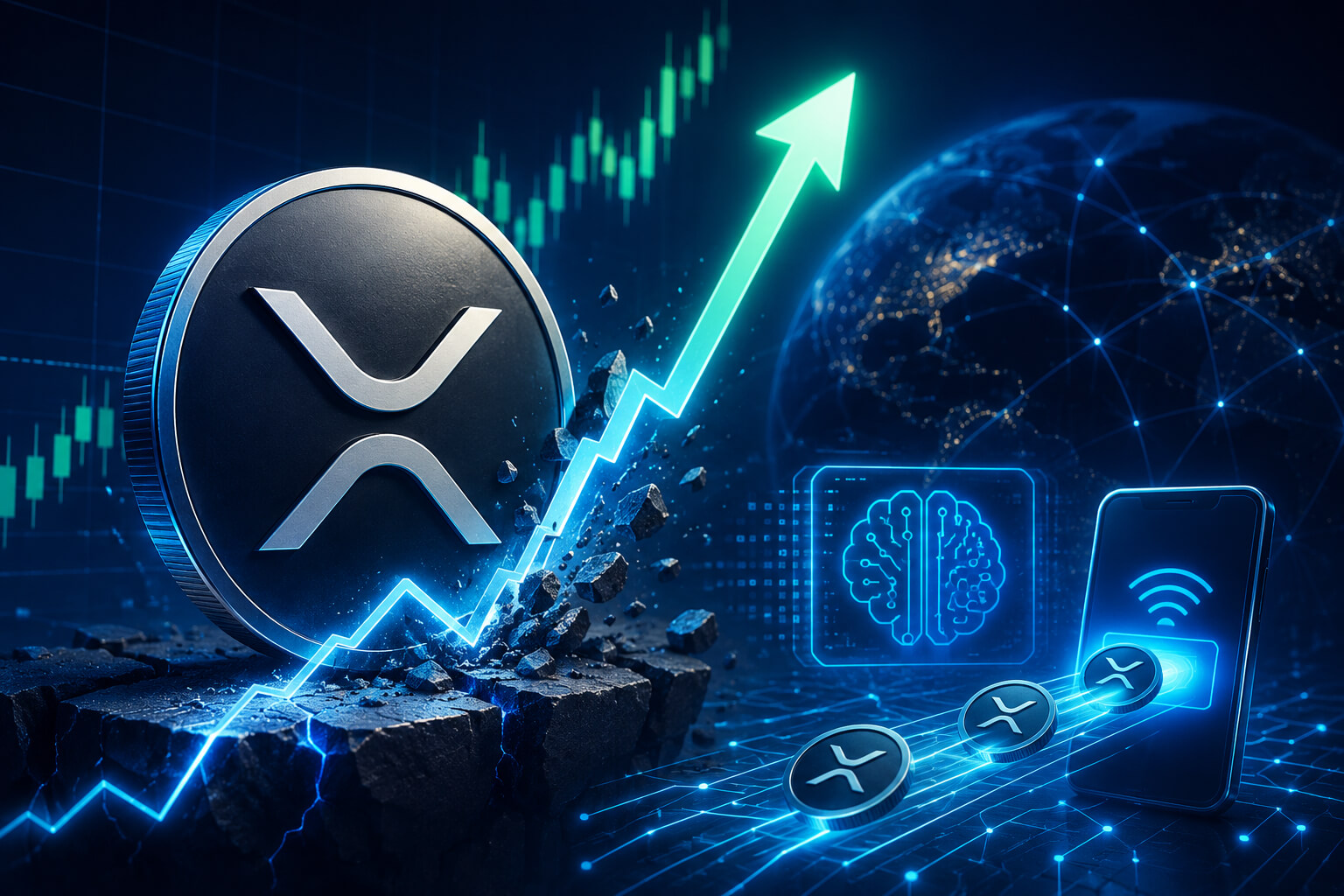
XRP has finally pushed through a resistance level that had been frustrating buyers for weeks. The move was not explosive, but it was enough to change the short-term picture.
The token climbed nearly 4% to a two-week high of $1.1574 before giving back part of the gain. XRP later traded near $1.14, keeping its price above the resistance line it had recently broken.
Several things arrived at once. Bitcoin moved back above $65,000. Large XRP wallets continued accumulating tokens. Spot exchange-traded funds recorded fresh inflows. Then came a less familiar catalyst: artificial intelligence agents have now completed more than 1 million transactions on the XRP Ledger.
That last number may end up being more interesting than the price chart.
XRP Price Breaks Resistance After Weeks of Tight Trading
XRP broke above the upper boundary of a symmetrical triangle that had formed following its June decline. The price also cleared a descending trendline connecting a series of lower highs recorded during June and July.
The breakout carried XRP to $1.1574 before sellers appeared around the $1.16 area. Even after the pullback, the token remained above the former resistance zone, leaving buyers with a chance to defend the move rather than start all over again.
Daily momentum indicators also improved. The relative strength index moved above its own average while staying below overbought territory. Meanwhile, the moving average convergence divergence histogram turned positive, suggesting that buying pressure had started to rebuild.
It is a better chart than XRP had a few weeks ago. Not a clean victory yet.
For the breakout to gain more credibility, buyers may need to reclaim the area around $1.1475 and challenge resistance near $1.16 again. Above that, the chart points toward possible barriers at approximately $1.17, $1.18 and eventually the psychological $1.20 level.
XRP Ledger AI Payments Cross the 1 Million Mark
Away from the price action, the XRP Ledger passed a notable network milestone. More than 1 million “agentic” transactions have now been processed as developers experiment with AI-powered payment systems.
Agentic payments allow software to make transactions automatically based on programmed instructions. Instead of waiting for a person to approve every small transfer, an AI agent could request an application programming interface, purchase data, pay for computing power or settle a digital service directly.
The payment happens as part of the software workflow.
That matters because many AI services will likely involve tiny, frequent transactions. Traditional payment systems were not built for autonomous software making thousands of low-value purchases in real time. Blockchain networks, at least in theory, offer a cleaner route.
XRPL can settle transactions within roughly three to five seconds and offers relatively predictable costs, making it one of several networks competing for this emerging machine-payment market. Ripple has also introduced tools allowing AI agents to send and receive payments using XRP and its dollar-backed RLUSD stablecoin.
Why AI Agents Could Become a New XRP Use Case
RippleX engineering head J. Ayo Akinyele believes the number of agentic transactions could rise sharply as developers improve the infrastructure surrounding autonomous payments.
He projected that XRPL could move beyond 10 million transactions and possibly reach 100 million within the next several years. That is a forecast, not guaranteed demand for XRP, but the direction is worth watching.
The real test will be what those agents are buying.
A million experimental transactions can generate attention without creating much economic value. Regular payments for data, cloud resources, software tools and online services would tell a stronger story. So would higher payment volume, more active applications and developers choosing XRPL over competing networks.
Ripple is entering a busy market. USDC already dominates much of the activity running through the x402 payment standard, which allows software to complete blockchain payments directly inside normal web requests. XRP and RLUSD now have a seat at the table, although they still need developers and payment volume to follow.
XRP Whales Keep Accumulating While Smaller Holders Sell
Large wallets have also supported the latest XRP recovery.
Santiment data showed that wallets holding between 100,000 and 100 million XRP increased their combined balances by approximately 2.8% over five weeks. During the same period, balances held by wallets containing less than 0.1 XRP fell by 5.2%.
The numbers suggest larger holders were building positions while some of the smallest accounts reduced their exposure.
That does not prove whales caused the rally. Crypto markets rarely offer such a neat explanation. Still, sustained accumulation can reduce the amount of XRP available for immediate sale, especially when it happens alongside improving sentiment and institutional inflows.
The timing helped. XRP’s rebound toward $1.16 arrived while those larger wallets were still adding to their holdings.
Spot XRP ETFs Add Fresh Capital
US-listed spot XRP ETFs recorded $5.66 million in net inflows on July 21, lifting cumulative inflows to approximately $1.49 billion.
Franklin Templeton’s XRPZ reportedly accounted for the full daily addition, while other listed products recorded no net movement. Total trading value across the funds reached approximately $19.16 million, with combined net assets of around $1.06 billion.
Those assets represented roughly 1.48% of XRP’s overall market capitalization at the time.
ETF flows can change quickly, so one positive day should not carry too much weight. Even so, continued inflows show that regulated investment products remain part of the XRP market story. They also give institutional and traditional investors another way to gain exposure without directly managing tokens or private keys.
XRP Still Needs to Hold the Breakout
The immediate risk is fairly simple: XRP could fall back below the level it just escaped.
A close below approximately $1.123 would weaken the short-term structure and place attention on support near $1.1106 and $1.0986. A deeper decline could expose areas around $1.0864 and $1.0742.
That would not erase the AI payment milestone, whale accumulation or ETF inflows. It would show that those catalysts were not enough to overcome sellers—at least not yet.
Momentum on the four-hour chart had already started cooling after XRP’s rejection near $1.1574. The MACD remained positive, but its shrinking histogram suggested the initial push was losing strength.
Buyers now have to defend the breakout. Crypto traders have seen plenty of resistance breaks disappear within a few candles.
AI Payments Give XRP a Story Beyond Price Speculation
The XRP price breakout will attract traders, but the network activity behind it deserves separate attention.
More than 1 million AI-agent transactions will not automatically send XRP toward $1.20 or beyond. It does, however, show that autonomous payments are moving out of slide decks and into live blockchain testing.
That is the more unusual part of this story.
XRP has spent years being discussed mainly as a cross-border settlement asset. AI agents now introduce another possibility: software paying other software for data, services and computing resources without waiting for a human to click “approve.”
Whether that becomes a serious source of XRP demand remains unanswered. For now, XRP has a stronger chart, fresh ETF inflows and a new network milestone arriving at roughly the same time.
The breakout is real. Holding it will be the harder part.
This article is for informational purposes only and does not constitute financial or investment advice.