
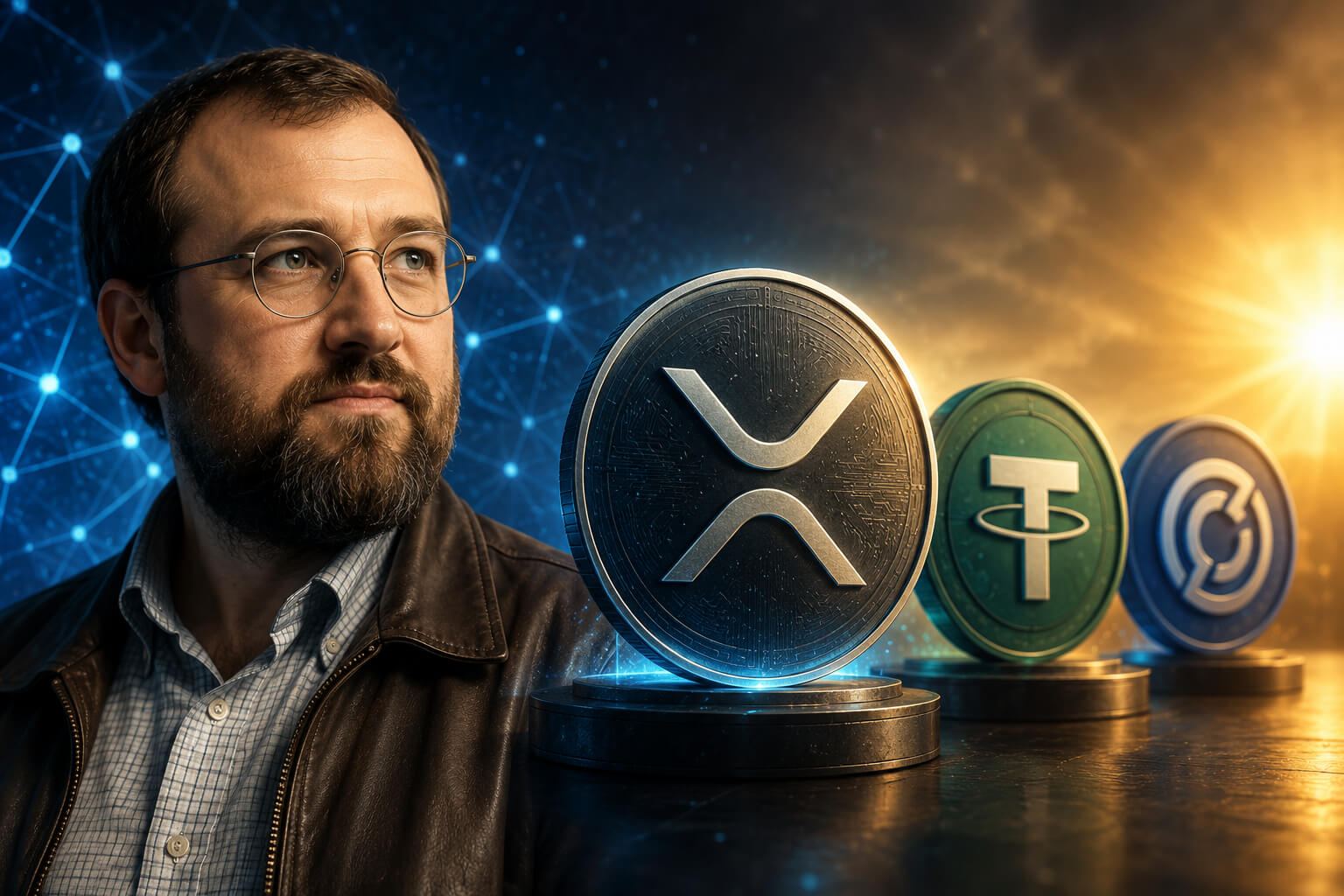
In his latest statements, Cardano‘s founder, Charles Hoskinson, praised the XRP cryptocurrency, stating that its Web2.5 approach is better than that of Tether and Circle.
According to crypto news, Hoskinson expressed his support of XRP, which comes as a surprise due to the long-lasting tension between Hoskinson and XRP community members. Hoskinson explained that the reason why he supports XRP is in the fact that developers and users can access the XRP ledger without needing permission from the issuing company.
Hoskinson Praised the Openness of XRP Ledger
As crypto news reports, Hoskinson stated that he believes XRP as a Web2.5 product is superior to both Tether and Circle. The Cardano founder explained that XRP Ledger’s openness was the main reason why he supports it.
“Open standards, open protocols, open ecosystem,” he was quoted by crypto news.
In essence, the reason why Hoskinson supported the cryptocurrency was the fact that XRP Ledger could be accessed by builders without having to receive permission from any corporate entity, whereas both stablecoins operate in a centralized manner.
For instance, access to Tether or Circle networks would be controlled by the issuer corporation, including compliance requirements, asset reservations, and account freezes.
Tether and Circle Remain Popular Issuers of Stablecoins
Although there are other stablecoin issuers out there, Tether and Circle remain popular stablecoin providers with high market capitalizations. Their business models rely on centralized issuance and distribution of stablecoins.
However, Tether and Circle issuers retain the right to freeze assets and ban particular addresses. Additionally, these companies need to operate in accordance with strict compliance requirements.
Why It Was Important to Compare XRP With Stablecoins
As crypto news reported, the market of stablecoins reached new milestones in April 2026. Thus, the total supply of fiat-backed stablecoins exceeded $319 billion, whereas adjusted stablecoin transaction volumes reached $10.9 trillion in 2025.
Under these circumstances, Charles Hoskinson’s support of the XRP currency could be explained by his concern about decentralized vs. centralized crypto payments.
From that perspective, the support of XRP and XRP Ledger could be interpreted as a stance against centralized financial solutions in favor of permissionless networks.
Surprising Endorsement From XRP Tension Figures
Hoskinson’s comment is particularly interesting, considering the fact that he had many conflicts with some of the community members. Specifically, the Cardano founder was often accused of favoring Ethereum in terms of regulatory matters.
Some members of XRP community believed that Ethereum benefited from a certain advantage in comparison with Ripple and XRP before Ripple received the negative decision from the U.S. Securities and Exchange Commission.
At that time, Hoskinson dismissed such accusations and stated that he had left the Ethereum Foundation back in 2014. However, Hoskinson still seemed to believe that the XRP Ledger had advantages compared to its competitors.
Cardano Faces a Governance Dispute
The statements of Hoskinson also come amid Cardano’s discussions about its governance system. In particular, the Cardano creator is currently running a review of 11,000 DAOs, focusing on governance structures, executive power, strategies, and roadmaps.
Additionally, Cardano recently experienced a treasury dispute over 32.9 million ADA needed for funding IOG‘s research lab for another year. As crypto news reported, 81% of active stakeholders voted against the proposition.
Therefore, Hoskinson’s comments on XRP and its competitors could be viewed within the framework of the governance debate.
Implications of Hoskinson’s Comments for XRP and Its Rivals
First, it needs to be noted that the comments do not mean that Cardano and XRP are currently aligned on all issues. Nevertheless, the opinion of one of the most prominent blockchain industry leaders demonstrates that blockchain founders can find common ground sometimes.
As for XRP, the comments will definitely please its enthusiasts. On the other hand, they can serve as arguments for XRP supporters in the ongoing regulatory discussion regarding stablecoins.
Specifically, Hoskinson’s comments demonstrate that some people see a future for the stablecoin market in decentralized and permissionless blockchains rather than in regulated corporations.